
The Noble Tarot, Misunderstood
In France, tarot was a game for long summer nights, not an occult instrument. Its forgotten history reaches back to Renaissance Italy, perhaps beyond.
Living in New York, I never expected that a visit to the Morgan Library would deepen my understanding of a game I had been playing since youth in France. I remember long nights on vacation, playing until the early morning hours. I was the newbie among a very smart, high-IQ crowd, but I learned from excellent players and quickly got hooked. I played it with teenagers when I was leading summer camps, and even with art-schoolmates on adventures in the Sahara Desert. Somehow, I always carried a deck with me when I traveled.


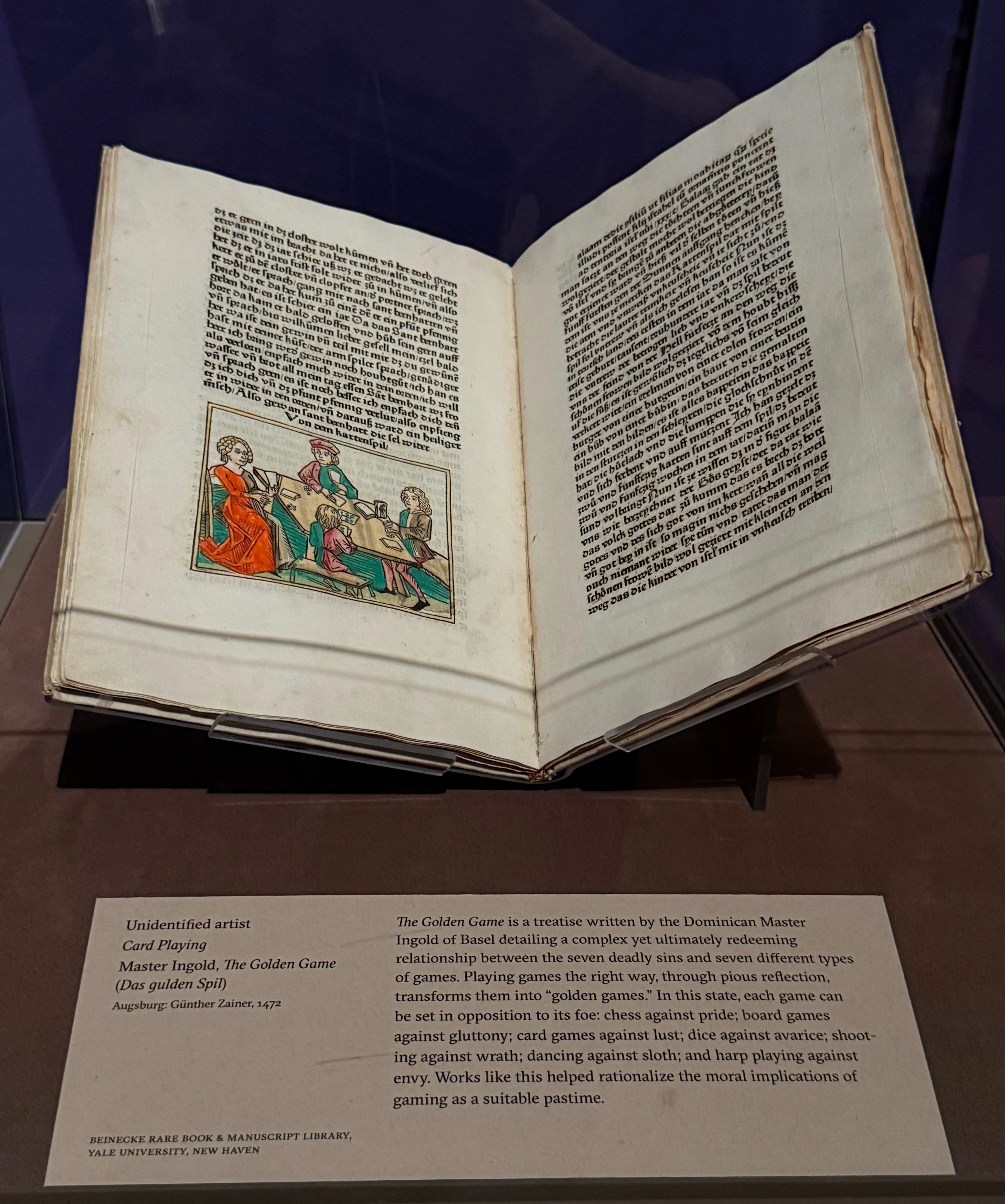
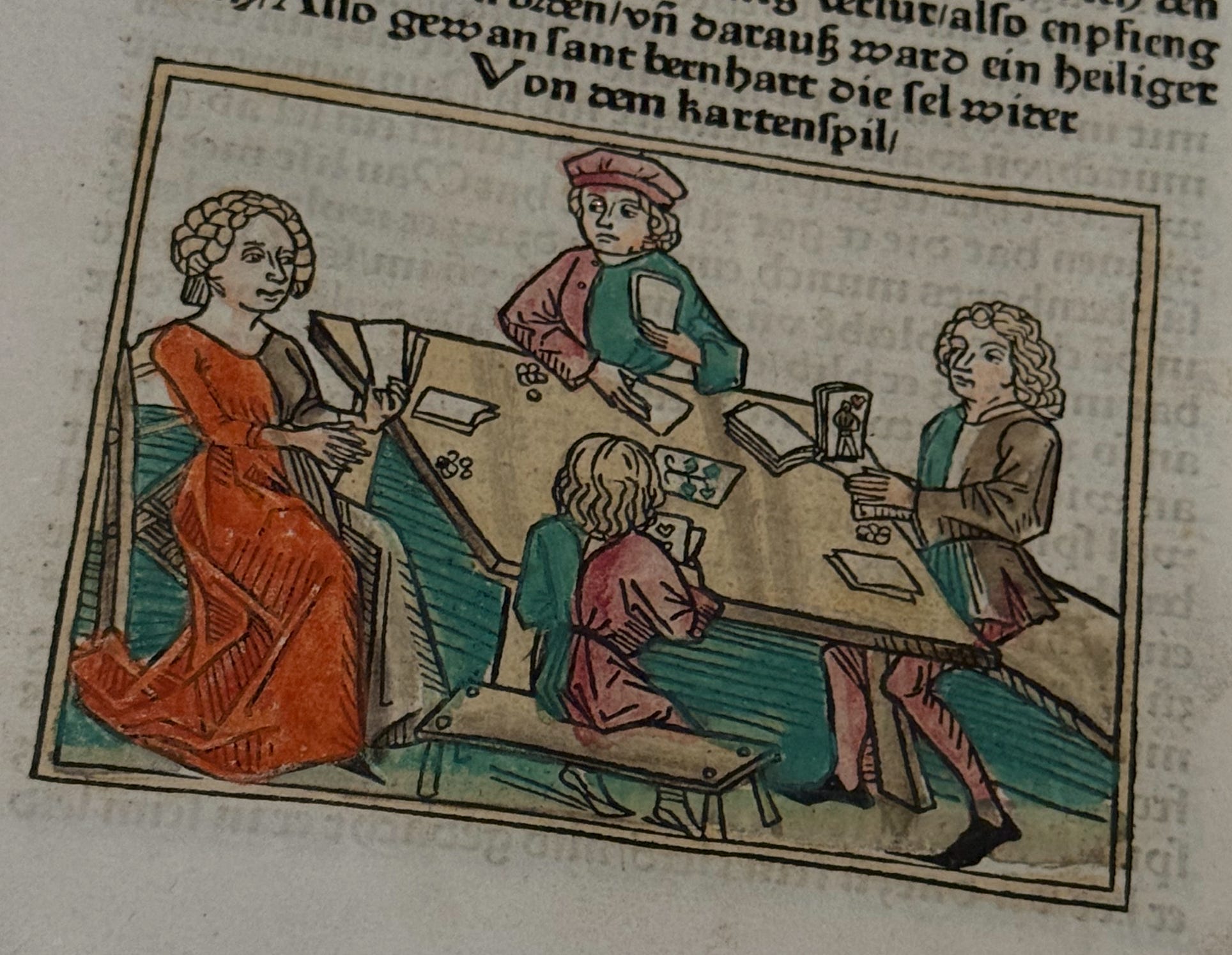
I eventually learned that tarot spread across the world through the movements of history, through the hands of French soldiers or Swiss merchants. Tarot most likely crossed into France when French forces took Milan and the Piedmont in 1499, and the game’s real golden age as a pastime, the centuries when it was played the way I was taught to play it, ran roughly from 1730 to 1830. Somewhere in that long migration, a strategy game respectable enough for nobility, what fifteenth-century Italians called a giuoco d’ingegno, a game of skill spoken of with the same respect as chess, became, outside France, a synonym for fortune-telling instead. That puzzle stayed with me. I introduced the game to friends in the U.S., but they could never quite reach the level of play and mastery I had experienced in France. While most French people know of the game, it is actually rare to find that same level of passion I feel for it.
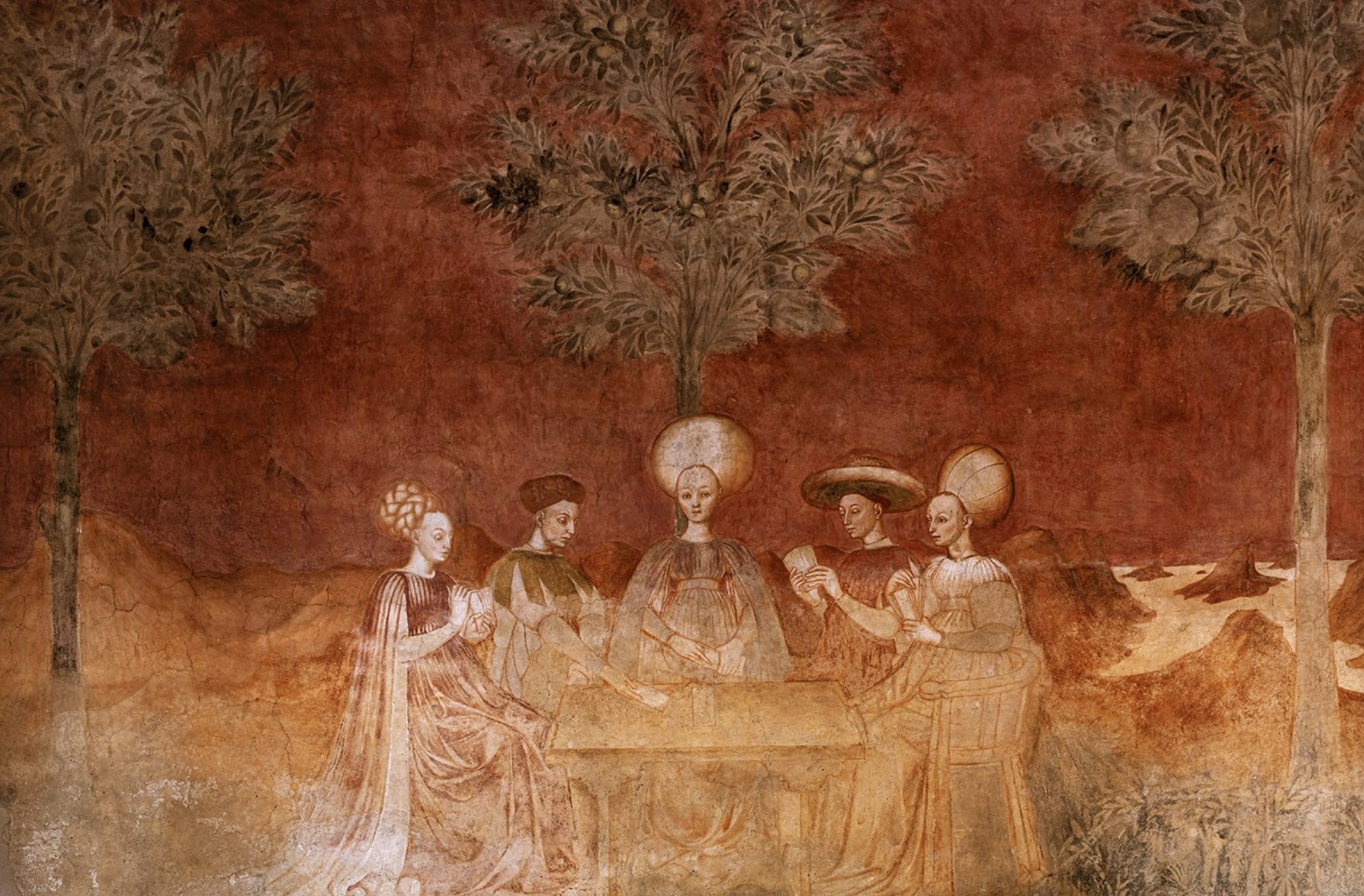
Later, as a student at the Avignon art school, a teacher named Serge Boyer helped me understand the cards through a different lens. The imagery we know today, the Fool, the Lovers, Time, Death, the Devil, actually emerges from Renaissance visual culture. These figures were arranged in a hierarchy, from lowest to highest, inspired by Petrarch’s poem I Trionfi (The Triumphs), where one allegorical figure literally “triumphs” over, or beats, another. This is why the cards were originally called carte da trionfi. This is actually the principle of the card game I played.
My connection to Avignon turned out to be historically significant. Sources I found note that tarot was naturalized in Provence and Avignon during the stay of the Papal Court when high-ranking Italians brought the game with them. This is still a bit controversial and debatable, you can read the alternative theory by Jean Vérame here.
What I didn’t fully appreciate until I began researching the Morgan Library exhibition was that I had unknowingly stepped into this history rather than simply studying it from a distance. Avignon and the surrounding region remained papal territory long after the popes returned to Rome in the fourteenth century and that unusual jurisdiction shaped tarot’s future. Because the city was exempt from French royal taxes, it became a center for the cheap large-scale printing of tarot decks beginning in the 1500s and helped spread the game throughout France and beyond.


I knew none of this when Boyer assigned us the task of designing our own decks from scratch. I only knew I was drawing cards in a city with a long papal history. Standing before those surviving decks at the Morgan Library, I couldn't help thinking about the old tarot deck still sitting in my own closet. Five centuries or twenty years, survival changes the way we look at an object, but not necessarily what it is. Only later did I realize that I had been drawing those cards in the middle of tarot's own printing history, on tax-free papal ground, centuries before I would carry the game from Avignon to America, unknowingly retracing a much older journey.

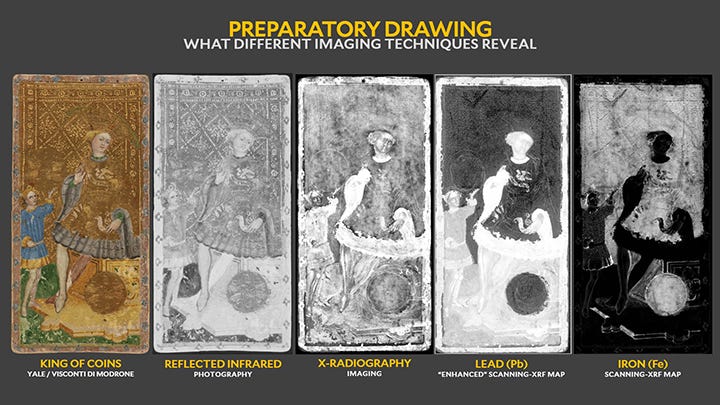
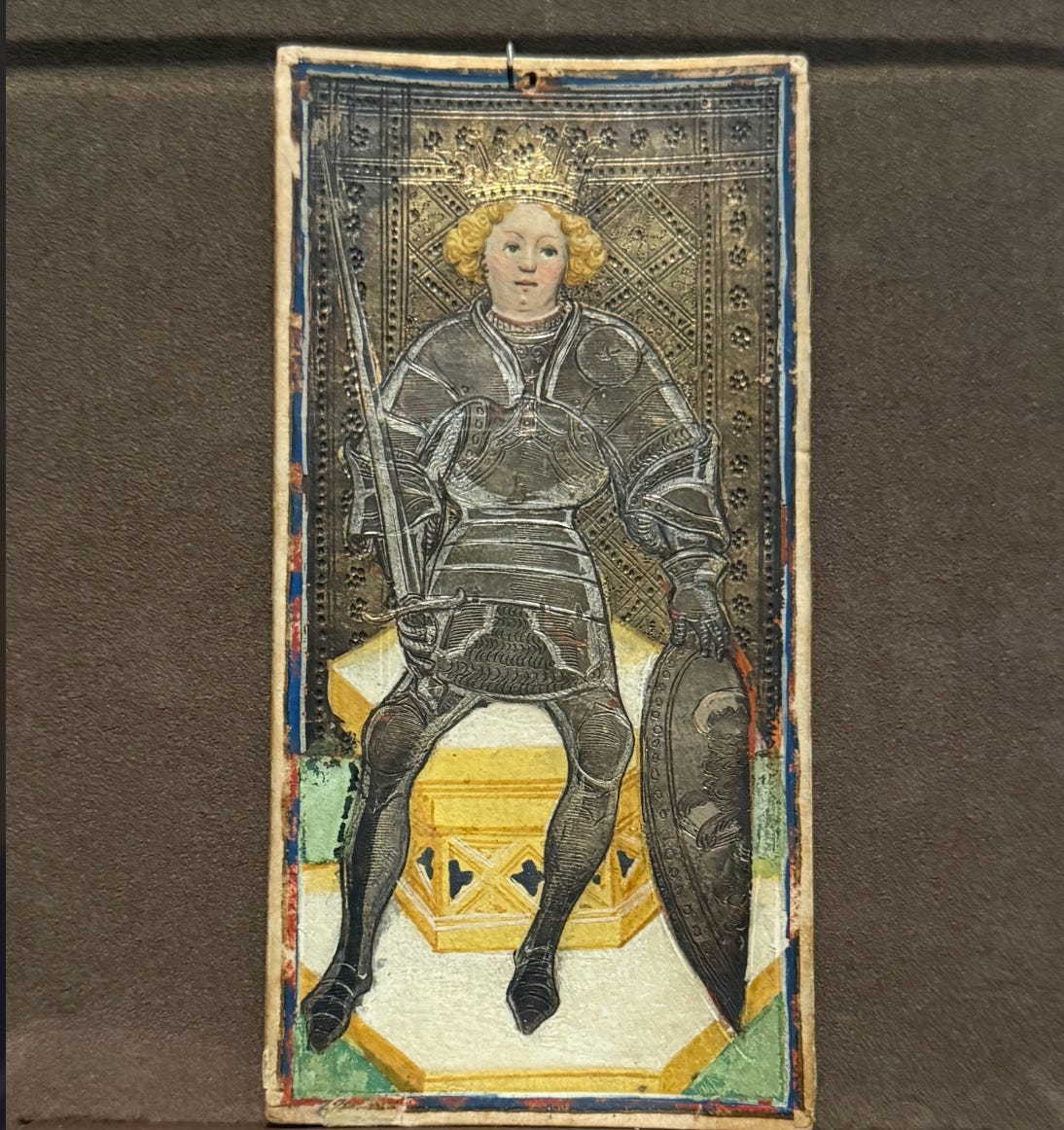
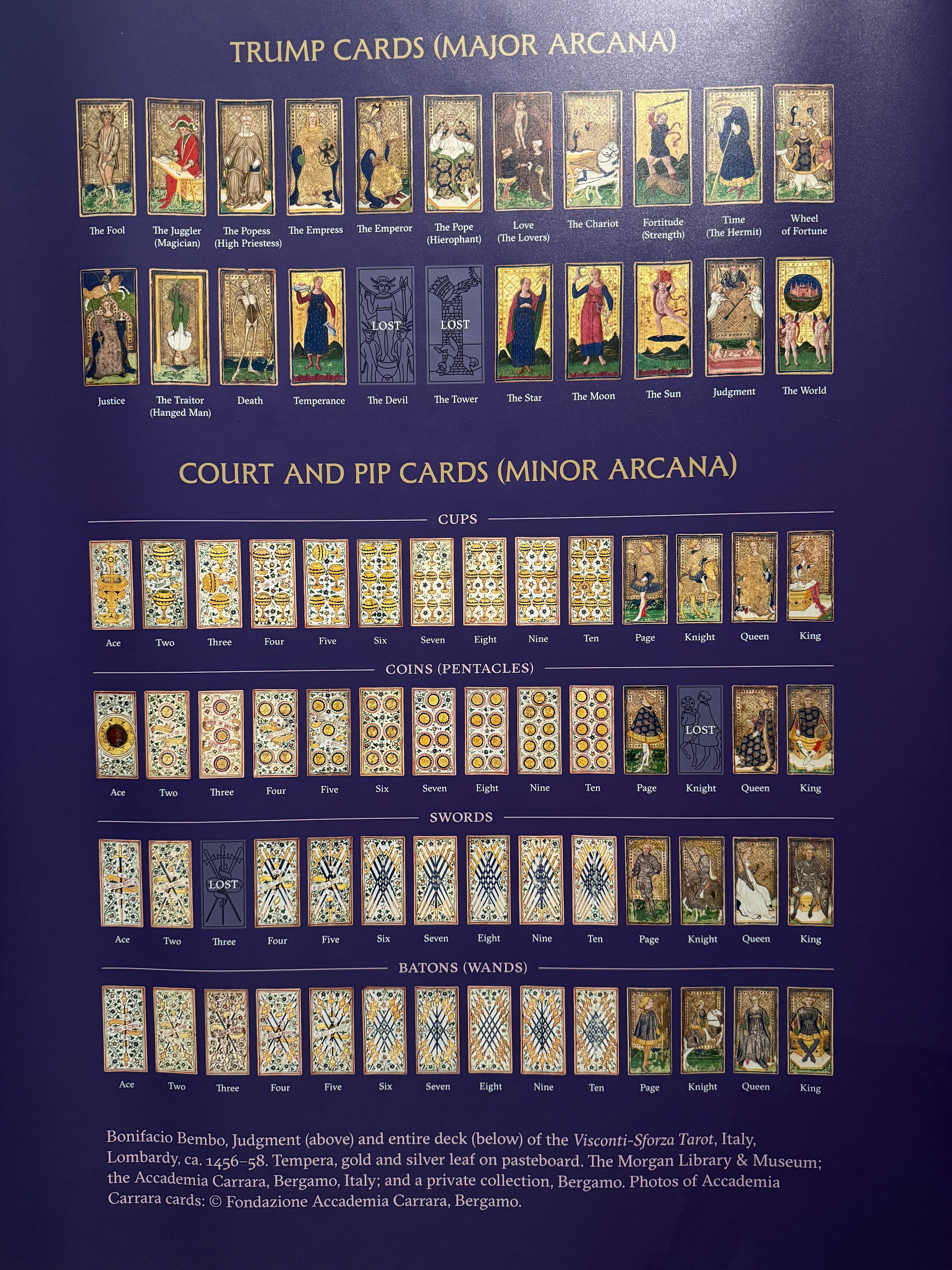
Now, if you visit the Morgan Library in New York, you can see the Visconti-Sforza deck, while Yale holds the Visconti di Modrone and the Pinacoteca di Brera holds the Brambilla deck. These aren’t just cards; they are handheld jewels, painted by court artists like Bonifacio Bembo for the Dukes of Milan. Material studies have revealed they were constructed like a seven-layer cake, combining traditions of panel painting, drawing, and manuscript illumination.


Not every deck was so lucky. The earliest known reference to a tarot-like game describes a deluxe pack commissioned by Duke Filippo Maria Visconti from the court artist Michelino da Besozzo, sixteen classical gods, four suits of birds instead of swords and cups, and a price tag of 1,500 ducats, more than ten times a courtier’s annual salary. That deck is gone entirely. Standing in front of the ones that did survive.
The 18th-Century Pivot: From Game to "Royal Path"
“It teaches them at the same time by the Player at Cups and the Wheel of Fortune, that nothing is more inconstant in this world than various states of man: that his only refuge is in virtue, which never fails when needed”.
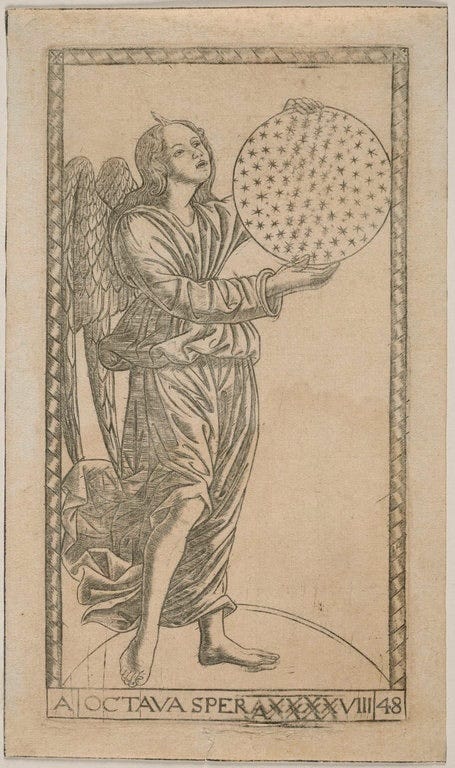
This profound moral lesson is the cornerstone of Antoine Court de Gébelin’s 1781 reinterpretation of the tarot, which he published in the eighth volume of his massive work, Monde Primitif. By framing the cards as a philosophical guide rather than a mere game, he provided the foundational narrative for divination movements.
Drawing from the sources, here is the historical and symbolic context for this perspective:
The “Royal Path of Life”
Court de Gébelin, who was a protestant linguist and freemason, theorized that the word “Tarot” was pure Egyptian: “Tar” meaning “way” or “path,” and “Ro” meaning “king” or “royal”. This “Royal Path” was designed to map the “entire life of citizens,” following them from birth to death and illustrating the “physical and moral guides” they must follow, such as the King, Queen, and religious leaders.
Lessons in Inconstancy
To Court de Gébelin, the deck was a visual sermon on the fragility of worldly status:
The Player at Cups: The Juggler’s Skill: In the Renaissance, The Player at Cups was a "stock figure"; a street performer or juggler using cups and balls. To a Renaissance player, he represented human skill and the element of chance inherent in the game. Gébelin took this figure and gave him an "Oriental" name, Pagad ("Lord of Fortune"), to transform him from a clever game-player into a mystical master of Fate. He turned the juggler’s table of tricks into a "perpetual game of chance" that mirrors human existence.
The Wheel of Fortune: Visual Continuity: Both the Renaissance aristocrats and Gébelin viewed this card as a satire on power. Renaissance artists like Bonifacio Bembo depicted the wheel to remind players (who were often dukes and kings) of the instability of their own status. Gébelin kept this Renaissance imagery of animals/humans rising and falling but argued it was a specific lesson on the "inconstancy of the various states of man".
The "Safe Conduct" of the Luxury Object: The Visconti-Sforza cards were "handheld jewels" made with gold leaf and lush paint for the elite. Gébelin’s theory explains a historical miracle: why these delicate "seven-layer" masterpieces survived centuries of "barbarity" and war. He argued that because they were seen as "frivolous" toys, no one thought to destroy them as "dangerous" books of wisdom.
The Social Structure
Gébelin “discovered” that the four suits represented the hierarchical social classes of ancient Egypt:
Swords: The Military and Nobility.
Cups: The Priesthood.
Batons (Clubs): Agriculture.
Coins: Commerce.
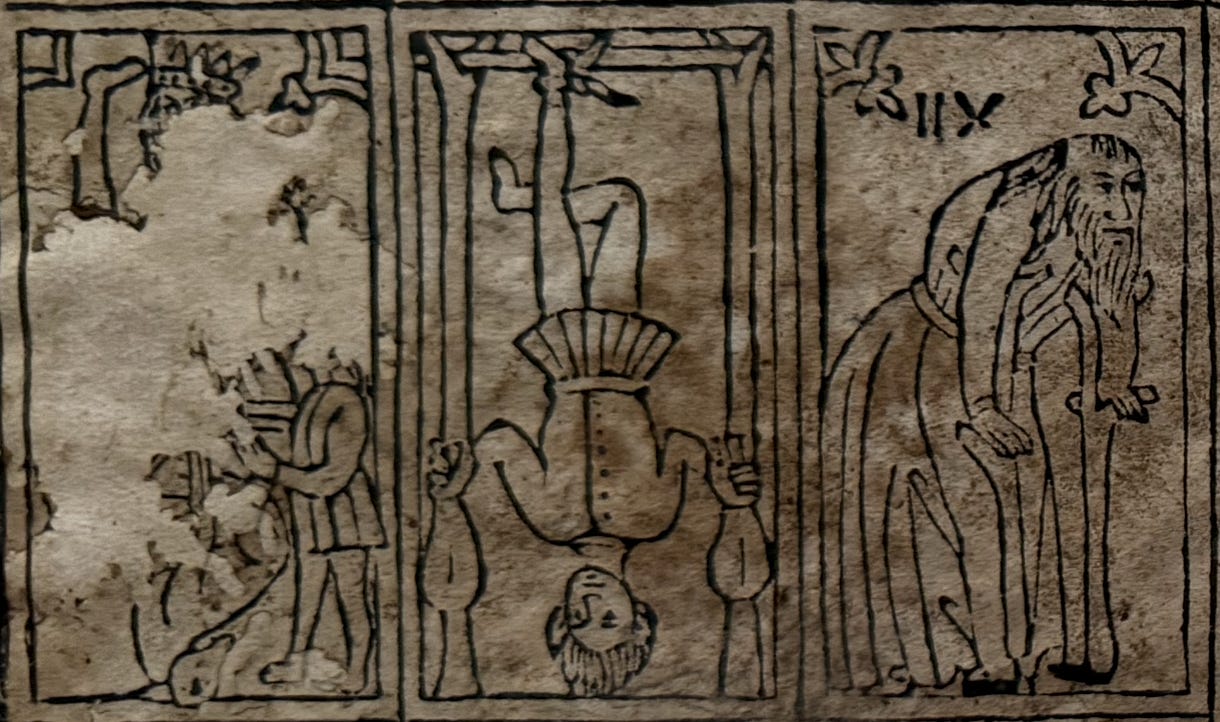
He even claimed that modern card makers had “mutilated” the original symbols. For instance, he argued that the Hanged Man (XII) was originally Prudence, depicting a man standing with one foot suspended as he cautiously chooses his next step, rather than a man hanging by his feet.
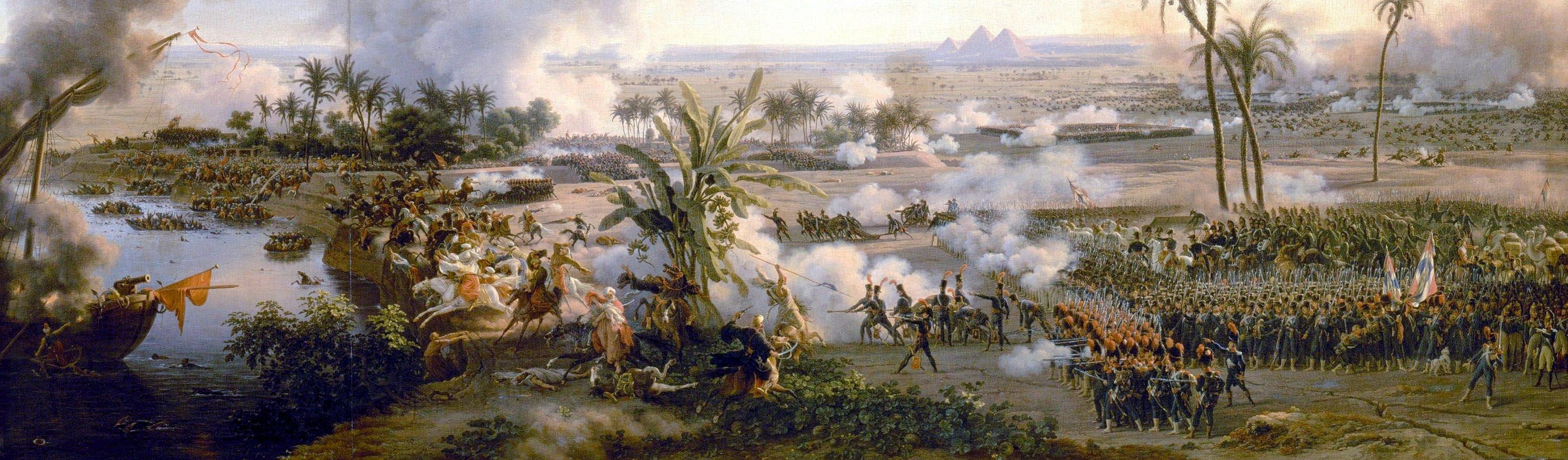
Gébelin missed seeing Napoleon’s ascent by a few years, yet both were captivated by Egypt as a land of secret wisdom: Gébelin by casting the tarot as an Egyptian Book of Wisdom, Napoleon by invading Egypt in 1798 and fostering archaeological discoveries. This shared fascination spread even farther, as Napoleon’s troops are thought to have introduced tarot (via the game of Droggn) into the Austrian Tyrol.
Ide love to see the set you made!